
Episode #6. Roman Grygoriv and Illia Razumeiko’s Archeological Operas

apple_smyoutube_smspotify_smamazon_sm

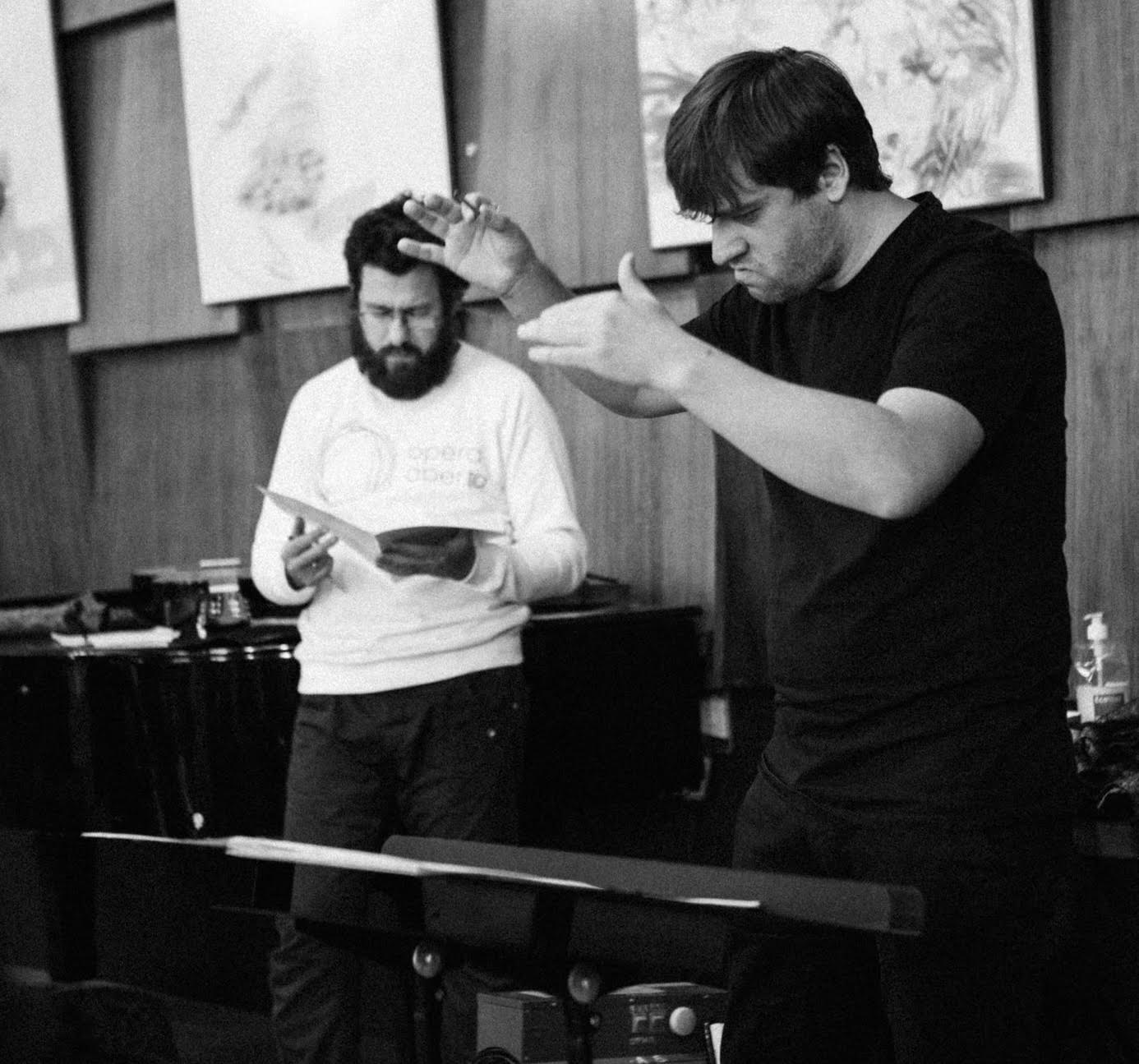
This episode provides an overview of the major works by award-winning composer duo Roman Grygoriv and Illia Razumeiko – creators of 12 operas and founders of Opera Aperta, a laboratory of experimental opera in Kyiv. Plunging into their unique archeological process of creation, we position their work alongside the music and the ideas of major 20th – 21st century artists and intellectuals: Richard Foreman, David Lynch, Jorge Louis Borges, Umberto Eco, Les Kurbas, Hanna Havrylets, Karlheinz Essel, and Jorge Sánchez-Chiong.

Grygoriv and Razumeiko’s Chornobyldorf won the Opera and Music Theatre Award by the Royal Philharmonic Society in 2024 and received eight sold-out shows at LaMaMa Experimental Theatre Club in New York. Their most recent work, GAIA-24. Opera del Mondo, will be presented at O.Festival in Rotterdam and at the Venice Biennale.
Playlist

Chornobyldorf, archeological opera in seven novellas
Roman Grygoriv and Ilia Razumeiko (music, libretto, directing, dramaturgy, scenography)
BBC Radio 3

Untitled, rock band “Karna”
Live concert recording, Ivano-Frankivsk, 1999

Mass in B minor BWV 232, J. S. Bach
The Netherlands Bach Society
Jos van Veldhoven, conductor
Hana Blažíková, soprano 1
Anna Reinhold, soprano 2
David Erler, alto
Thomas Hobbs, tenor
Peter Harvey, bass

Prayer to the Virgin Mary, Hanna Havrylets
Chamber Choir “Kyiv”
Mykola Hobdych, conductor

TAU XII – Jesus stirbt am Kreuz, Karlheinz Essl
Tanja Elisa Glinsner: mezzo soprano, conducting
Elisabeth Möst, flutes
Andreas Schablas, clarinets
Daniel Loipold, french horn
Eva Maria Mitter, accrodion
Barbara Körber, cello

Crin, Jorge Sánchez-Chiong
Patricia Kopatchinskaja, violin

IYOV, Opera-requiem, Roman Grygoriv & Illia Razumeiko
Vlad Troitskyi, producer
Maryana Golovko, soprano
Anna Kirsh, soprano
Oleksandra Mailliet, mezzo-soprano
Andriy Koshman, baritone
Ruslan Kirsh, baritone
Yevgen Rakhmanin, bass
Zhanna Marchinska, cello
Andriy Nadolskiy, percussion
Tatiana Troitska, voice
Illia Razumeiko, grand piano
Roman Grygoriv, conductor

Babylon, opera-circus, Roman Grygoriv & Illia Razumeiko
Vlad Troitskyi, producer
Maryana Golovko, soprano
Anna Kirsh, soprano
Andriy Koshman, baritone
Ruslan Kirsh, baritone
Yevgen Rakhmanin, bass
Zhanna Marchinska, cello
Andriy Nadolskyi, percussion
Nazar Spas, french horn
Artem Shestovskiy, сlarinet
Roman Grygoriv, conductor, guitar, bass
Illia Razumeiko, grand piano, toy piano
Tatiana Troitska, voice

The Ark, opera-ballet, Roman Grygoriv & Illia Razumeiko
Vlad Troitskyi, producer
Maryana Golovko, soprano
Anna Kirsh, soprano
Andriy Koshman, baritone
Ruslan Kirsh, baritone
Yevgen Rakhmanin, bass
Zhanna Marchinskaya, cello
Andriy Nadolskiy, percussion
Georgiy Potopalskyi, live electronics
Roman Grygoriv, conductor, guitar, bass
Illia Razumeiko, grand piano

GAZ, opera-dystopia, Roman Grygoriv & Illia Razumeiko
Virlana Tkacz, libretto and staging
Maryana Holovko / soprano
Anna Kirsh / soprano
Oleksandra Mailliet / mezzo-soprano
Andrey Koshman / baritone
Ruslan Kirsh / baritone
Eugen Rakhmanin / bass
Illia Razumeiko / piano
Zhanna Marchinska / cello
Nazar Stets / double bass
Andrey Nadolskyi / percussion
Ayk Egyian / percussion
Igor Boychuk / trumpet, trombone
Sergyi Shava / tuba
Roman Grygoriv / conductor
Electronics, Georgiy Potopalskiy

Opera Lingua, Music theater in seven books, Roman Grygoriv & Illia Razumeiko
Olga Diatel, producer
The national ensemble of soloists “Kyiv Kamerata”
Dmytro Kuzmin / flute
Dmytro Fonariuk / clarinet
Oleh Nedashkivskyi / horn
Igor Boichuk / trumpet, trombone
Renat Imametdinov / trombone
Yaroslava Nekliaeva / harp
Georgiy Chernenko / percussion
Oles Sudomyr / percussion
Oles Manyk / percussion
Eduard Skrypa / violin
Dmytro Bondarenko / violin
Katerynа Khudiakova / violin
Anna Frolova / violin
Andrii Tuchapets / viola
Kateryna Suprun / viola
Zoltan Almashi / cello
Olga Driga / cello
Nazar Stets / contrabas
Razumeiko Illia / guitar, piano
Roman Grygoriv / Conductor
Marichka Shtyrbulova / Nona
Maria Potapenko / Decima
Khrystyna Slobodianiuk / Morta
Nazgul Shukaeva / Nut
Diana Ziabchenko / Alma
Yuliia Alieksieieva / Fabia
Solomiya Kyrylova / Viola
Georgiy Potopalskiy, Live-electronics

Stripsody (1966), Cathy Barberian
Cathy Barberian, voice

Erin (1980), Joan La Barbara
Joan La Barbara, voice

I’ve Told Every Little Star,” Jerome Kern and Oscar Hammerstein II
Melissa George, voice

Chornobyldorf, archeological opera in seven novellas, Roman Grygoriv & Illia Razumeiko
Yevhen Bal – Orfeo / Dionysus
Anne Bennent – Eurydice
Marichka Shtyrbulova – The Little Accordeon girl
Diana Ziabchenko – Dafne
Susanna Karpenko – Susanna
Yuliia Alieksieieva – Venere
Evgeny Malofeev – Ulysses
Anna Rudenko – Hannah
Ihor Boichuk – Heron
Nazgul Shukaiieva – Inanna
Mariia Potapenko – Urania, Young Eurydice
Khrystyna Slobodianiuk – Elektra
Georgii Potopalskyi – Pluto
Roman Grygoriv – Aristoxenos
IIlia Razumeiko – Pythagoras
Live-electronics: Georgiy Potopalskiy
Rhea-player creation – Winfried Ritch
The Orchestra of the Chornobyldorf: Roman Grygoriv – microtonal cymbals and guitar, Illia Razumeiko – microtonal bandura and guitar, Zoltan Almashi – cello, Ihor Boichuk – percussion
Roman Grygoriv – conductor

You can find more information about each opera and the dates of Opera Aperta’s upcoming tours here.

Selected Bibliography

We are grateful to the following individuals and organizations:

  • La Mama Experimental Theater Club for hosting 8 shows of Chornobyldorf and providing space for an interview with the composers
  • Olga Diatel and Proto Producia for bringing Opera Aperta to New York
  • Prototype Festival for inviting Opera Aperta (2024) and Nova Opera (2018) to New York
OPERA LINGUA. Glasperlenspiel, Homo Ludens 
CHORNOBYLDORF. Chronos II, Dramma per musica.

©2024 by Extended Techniques. All Rights Reserved.

Episode #5 Valentyn Silvestrov’s Endless Melodies and the “End of History”

apple_smyoutube_smspotify_smamazon_sm

“I think that creativity, which is evidence of the artistic path, is not merely a set of examples of different stages of development; rather, it transcends the temporary cultural situation in some mysterious way – this is the hope of every author.” Ukrainian composer Valentyn Silvestrov (b. 1937) wrote this in a letter to a friend in 1978, and his creative work indeed exemplifies the balance between timeliness and timelessness that characterizes the most compelling art. While tracing his artistic path from the avant-garde period of the 1960s, to quietness and simplicity triggered by his interest in Zen Buddhism, to his never-ending postludes and sublime bagatelles, we contemplate his intriguing statements about music and “the end of history.”

Having lived most of his life in Kyiv, Silvestrov recently began to respond to historical events. The episode ends with his vocal works dedicated to the 2014 Maidan protests and piano pieces motivated by his 2022 forced emigration to Berlin.

on ITunes

Playlist

Valentyn Silvestrov, String Quartet No. 1 (1974)
Lysenko String Quartet
Musica Non Grata, BMG/Melodiya CD

Valentyn Silvestrov, Spectra for chamber orchestra (1965)
The Leningrad Philharmonic Orchestra
Igor Blazhkov, conductor
Archival recording (recorded live in 1965)

“Melodia,” from Five Pieces (1961, dedicated to Igor Blazhkov)
Borys Demenko, piano
Borys Demenko, Ukrainian Piano Avant-garde (limited edition CD, recorded in 1970)

Valentyn Silvestrov, Symphony No. 3 ‘Eschatophony’ (1966)
Bruno Maderna, conductor
Archival recording (recorded live in Darmstadt, 1968)

Valentyn Silvestrov, Drama for violin, cello and piano (1970-71)
Jenny Lin, piano
Cornelius Dufallo, violin
Yves Dharamraj, cello
Koch Int’l Classics

Valentin Silvestrov, “The Dream,” from the cycle Quiet Songs (1973-1977)
Alexei Lyubimov, piano
Alexei Martynov, voice
Lyrics by Taras Shevchenko, from The Dream (Son, 1844)
Megadisc Classics

Valentyn Silvestrov, Symphony No. 5
Deutsches Symphonie-Orchester Berlin
David Robertson, conductor
Sony Classical

Valentyn Silvestrov, “Postludium III,” from Three Postludes (1981-1982)
Anja Lechner, Violoncello
Silke Avenhaus, Piano
ECM New Series

Valentyn Silvestrov, “Bagatelle I” and “Bagatelle III,” from Bagatelles (2005)
Valentin Silvestrov, Piano
ECM New Series

Valentyn Silvestrov, “Alleluia III, Night” (Ніч) from Alleluia (2006)
Latvian Radio Choir
Sigvards Klava, conductor
Ondine

Valentyn Silvestrov, “Prayer for Ukraine” (Молитва за Україну) from Maidan – 2014
Kyiv Chamber Choir
Mykola Hobdych, conductor
Bandcamp

Valentyn Silvestrov, “Anthem” (Гімн) from Maidan – 2014 a capella
Valentyn Silvestrov, piano and voice
Bandcamp

Valentyn Silvestrov, “And Glory, Mountains Blue, to You” (I вам слава), from Maidan-2014 a capella
Valentyn Silvestrov, piano and voice
Lyrics by Taras Shevchenko, from The Caucasus (Кавказ, 1845)
Bandcamp

Valentyn Silvestrov, “Elegy” from Eleven Pieces (2022)
Valentyn Silvestrov, piano
Recorded live in Berlin on March 17, 2022
Bandcamp

Valentyn Silvestrov, “Evening Serenade” from Silent Music for string orchestra (2002)
Münchener Kammerorchester
Christoph Poppen, Conductor
ECM New Series

Note that only excerpts from each piece are quoted in the program. Please consider purchasing complete recordings at the links above.

Works cited

Desyateryk, Dmytro. “We started out of pure interest.” Day (January 30, 2018).

Kukushkin, Viktor, dir. The birth of music: Composer Valentyn Silvestrov (1991).

Nesterenko, Oksana “A Forbidden Fruit? Religion, Spirituality and Music in the USSR Before Its Fall (1964–1991)” (Ph.D. diss., Stony Brook University, 2021).

Schmelz, Peter J. “Intimate Histories of the Musical Cold War: Fred Prieberg and Igor Blazhkov’s Unofficial Diplomacy.” In Music and International History, ed. Jessica Gienow-Hecht, 189-225. New York: Berghahn, 2015.

Schmelz, Peter J.“Valentin Silvestrov and the Echoes of Music History.” The Journal of Musicology, Vol. 31, No. 2 (Spring 2014): 231-271.

Sigov, Konstantin and Alla Vaysband, editors. Symposion: vstrechi s Valentinom Silvestrovïm [Symposion: encounters with Valentin Silvestrov]. Kyiv: Dukh i Litera, 2012.

Silvestrov, Valentyn and Sergey Pilyutikov. Dochekatysia Muzyky: Lektsii-besidy. Kyiv: Dukh i Litera, 2010.

Interview with Leonid Hrabovsky (New York, March 6, 2021)

Letter from Silvestrov to Hannelore Gerlach dated August 19, 1978 (Silvestrov Collection at Paul Sacher Stiftung).

Suggested reading

Schmelz, Peter J. Sonic Overload: Alfred Schnittke, Valentin Silvestrov, and Polystylism in the Late USSR. Oxford University Press, 2021.

Schmelz, Peter J. Such Freedom, If Only Musical: Unofficial Soviet Music During the Thaw. Oxford University Press, 2009.

Wilson, Samuel. “Valentin Silvestrov and the symphonic monument in ruins.” In Transformations of Musical Modernism, edited by Erling E. Guldbrandsen and Julian Johnson, 201-220. Cambridge: Cambridge University Press, 2015.

©2022 by Extended Techniques. All Rights Reserved.

Episode #3 The Ah of Steve Dalachinsky

apple_smyoutube_smspotify_smamazon_sm

This episode is a tribute to an award-winning downtown New York free-jazz poet and concert aficionado, Steve Dalachinsky. It features Dalachinsky’s studio and concert recordings with Thurston Moore, Tom Surgal, Vito Ricci, Vernon Reid, Matthew Shipp, Aaron Novik, Please the Trees, Pasquale Cangiano, Asiff Tsahar and Marcos Campello, and an interview with one of his publishers, Matvei Yankelevich.


on ITunes
Playlist
1. incomplete directions, Steve Dalachinsky (poetry) and Vito Ricci (electronics), incomplete directions (Knitting Factory Records, 1999).
2. in the book of ice #5 (this is a jazz poem not), Steve Dalachinsky (poetry), Thurston Moore (acoustic guitar), Tom Surgal (drums and percussion), incomplete directions (Knitting Factory Records, 1999).
3. slim slow swimmer, Steve Dalachinsky (poetry) and Vernon Reid (acoustic guitar), incomplete directions (Knitting Factory Records, 1999).
4. slim slow swimmer, Steve Dalachinsky (poetry) and Matthew Shipp (piano), incomplete directions (Knitting Factory Records, 1999).
5. Steve Dalachinsky & Please The Trees, live at Pianos, NYC, March 23, 2014.
6. Steve Dalachinsky (voice) and Pasquale Cangiano (trumpet), live at Islip Arts Museum (New York), September 14, 2019.
7. Fruit Flys, Steve Dalachinsky (poetry) and Asiff Tsahar (tenor saxophone), The Jewish alternative movement: a guide for the perplexed (Knitting Factory Records, 1998).
8. Erase me, poetry by Paulo Leminsky, Steve Dalachinsky (voice), Aaron Novik (clarinet), live at Berl’s Brooklyn Poetry Shop (New York), September 13, 2017.
9. Silence of silence, Steve Dalachinsky (voice), Marcos Campello (guitar), January 11, 2018, Spectrum (New York).
10. Ancestors, Steve Dalachinsky (voice), Marcos Campello (guitar), summer 2017, home recording (New York).
11. Pray for me, Steve Dalachinsky (poetry), Aaron Novik (clarinet), live at Berl’s Brooklyn Poetry Shop (New York), September 13, 2017.

Texts:
Jake Marmer, Two Poems By Steve Dalachinsky, Forward, June 25, 2010
Jake Marmer, Remembering Steve Dalachinsky, ‘Poems are everywhere, you don’t have to look far’, Tablet, September 20, 2019
Andy Battaglia, “He Held the Keys to the Gate’: Jay Sanders, Fred Moten, Charlemagne Palestine, and More Pay Tribute to Poet Steve Dalachinsky,” ARTNEWS, September 18, 2019
Alan Kaufman, “To Write Eternity On A Piece of Paper – Remembering Steve Dalachinsky,” NEWSWHISTLE, September 19, 2019.
Interview with Matvei Yankelevich, Brooklyn, New York, October 5, 2019.
Emails, messages, facebook posts and other communication from Steve Dalachinsky and his friends.

We are grateful to the following individuals and organizations for hosting Steve Dalachinsky readings as part of Ticún Brasil and Extended Techniques events:
Professor Domício Coutinho and the Brazilian Endowment for the Arts (October 20, 2012 and November 23, 2013)
Jared White and Farrah Field and Berl’s Brooklyn Poetry Shop (September 13, 2017)
Glenn Cornett and Spectrum (January 11, 2018)

1402989_448401578594307_1890413096_o(1)

Steve Dalachinsky, Alotro Lado (program host) and Yuko Otomo
(BEA, 2013)

steve_bea

Steve Dalachinsky, Erlena Dlu (program host) and Yuko Otomo
(BEA, 2012)

Excerpts from Clarice Lispector’s Breath of Life and The Passion According to G.H.
November 23, 2013 at the Brazilian Endowment for the Arts

mp3 file download

©2019 by Extended Techniques. All Rights Reserved.

Episode #2 The Voices of Phil Minton

apple_smyoutube_smspotify_smamazon_sm

In this episode we present selected works of British singer, trumpeter and composer Phil Minton, with a focus on his extended vocal techniques: from freely improvised abstract pieces for solo voice, unusual renditions of classical and jazz repertoire, avant-garde compositions inspired by Daniil Harms and Joseph Brodsky works to choral work based on the letters of Ho Chi Minh.
..brief teaser:

The episode also includes an exclusive recording of Minton’s only performance in the US in the past 10 years (with Axel Dörner on trumpet, C Spencer Yeh on violin+voice and Okkyung Lee on cello) and some of his personal insights from a phone interview by Extended Techniques.

Running time: 1 hour 53 minutes

mp3 download: The Voices of Phil Minton
on ITunes
Playlist

1) Phil Minton and Roger Turner, “Urgent,” Ammo (1984), Phil Minton (voice), Roger Turner (percussion). Leo Records (1998, 2006) http://www.leorecords.com/

2) Phil Minton “Dough song 8,” A Doughnut in One Hand (1998), Phil Minton (voice). FMP/Free Music Production

3) Phil Minton and John Butcher, “Joyweed,” Apples of Gomorath  (1999). Phil Minton (voice), John Butcher (tenor and soprano saxophone). Grob (2002)

4) Phil Minton, John Butcher, Roger Turner, Veryan Weston, “Mouthful of Ecstasy,” Mouthful of Ecstasy (1996), Phil Minton Quartet: Phil Minton (voice), John Butcher (saxophone), Roger Turner (percussion), Veryan Weston (piano).  Victo www.victo.qc.ca

5) Simon Nabatov, “Part 2” and “Part 3,” Nature Morte (2001). Simon Nabatov Quartet: Phil Minton (voice), Frank Gratkowski (as, cl, bcl, fl), Nils Wogram (trombone), Simon Nabatov (piano) Leo Records http://www.leorecords.com/

6) Simon Nabatov, “And That’s All,” A Few Incidents (2004), Simon Nabatov Octet: Phil Minton (voice), Frank Gratkowski (as, cl, bcl, fl), Nils Wogram (trombone), Ernst Reijseger (cello), Cor Fuhler (live electronics, keyolin), Matt Penman  (bass), Michael Sarin (drums), Simon Nabatov (piano). Leo Records http://www.leorecords.com/

7) Phil Minton and Veryan Weston, “Klang Nocturne,” Ways (1987), Phil Minton (voice), Veryan Weston (piano) ITM Records

8) Phil Minton and Veryan Weston, “Evening,” Songs From a Prison Diary (1993) Cleveland Watkins, Maggie Nicols, Phil Minton, Norma Winston, “Voices from Somewhere” choir.  Leo Records http://www.leorecords.com/

9) Phil Minton and Veryan Weston, “Magnificat,”  … past (2004), Phil Minton (voice), Veryan Weston (piano). ReR Records

10) Phil Minton and Okkyung Lee, “mu jin,” Annica (2011), Phil Minton (voice), Okkyung Lee (cello). Dancing Wayang Records http://dancingwayang.com/

11) Okkyung Lee, Phil Minton, Axel Dörner, C Spencer Yeh, “Untitled” (2012), Okkyung Lee (cello), Phil Minton (voice), Axel Dörner (trumpet), C Spencer Yeh (violin and voice). Extended Techniques

axel dörner on trumpet, phil minton on voice, c spencer yeh on violin+voice, okkyung lee on cello

12) Tom Cora, The Untraceable Cigar, “Diving bell”(1996) Roof quartet: Tom Cora (cello), Phil Minton (vocals), Luc Ex (guitar), Michael Vatcher (drums). Red Note

Photos © Peter Gannushkin 2012
Intro: Erlena Dlu, “Six improvisations de la pleine lune” (2012)

Special thanks to Phil Minton, Leo Feigin, Simon Nabatov, Okkyung Lee, Peter Gannushkin, Francois Baron and Alexander Ra.

If you enjoy the music included here, please consider purchasing the recordings at the record labels sites above, or at Downtown Music Gallery.

Phil Minton’s Feral Choir in Cologne.
A film by Pavel Borodin. Germany, 2012.

©2012 by Extended Techniques. All Rights Reserved.

Episode #1 John Cage: A Liberator of Sound

apple_smyoutube_smspotify_smamazon_sm

In the first episode of Extended Techniques podcast we cover contribution of John Cage to extending timber and compositional techniques: using any object to make music, development of new percussion instruments, prepared piano and electronics; invention of chance procedure and indeterminancy.

Following foreword to Silence, we talk about John Cage and his ideas in the way that exemplifies them.

John Cage – A Liberator Of Sound

..and 2 brief teasers:

Your hosts are Erlena Dlu and Alotro Lado

The John Cage Quintet: Lou Harrison, John Cage, Doris Dennison, Margaret Jansen, Xenia Cage

Playlist:

Running time 1.08 minutes

1. John Cage, “First Construction [in Metal]” for percussion sextet, with assistant (1939)
Amadinda Percussion Group
Hungaraton Recordings

2. John Cage, “Third Construction” (1941)
Amadinda Percussion Group
Hungaraton Recordings

3. John Cage, “BaCchanale” (1940)
William Grant
Nabore

4. John Cage, “Amores” (1943)
Amadinda Percussion Group
Hungaraton Recordings

5. John Cage, “The Perilous Night” (1944)
Margaret Leng Tan
New Albion Records

6. John Cage, “One for piano” (1987)
Stephen Drury
Mode

7. John Cage, “Cartridge music” (1962)
David Tudor, Takehisa Kosugi, Michael Pugliese, John Cage
Kew Gardens

8. John Cage, “Williams Mix” (1952)
Magnetic tape
Ellipsis Arts

9. John Cage, “Music of changes” (1951)
David Tudor
Hat Hut Records

10. John Cage, “Atlas Eclipticalis” (1961-62)
Ulrich Krieger – sopranino sax, soprano sax, alto sax
Tobias Rüger – tenor sax
Reimar Volker – alto sax, baritone sax
Kathrin Wagner – alto sax, tenor sax
Mode

11. John Cage, “Atlas Eclipticalis” (1961-62)
Friedrich Gauwerky, violoncello
Wergo

12. John Cage, “Atlas Eclipticalis” (1961-62)
The Orchestra of the S.E.M. Ensemble
Petr Kotik (conductor)
Joseph Kubera (piano)
Wergo

Also, the following works are quoted throughout the podcast:

“John Cage and David Tudor, Indeterminacy: New Aspect of Form in Instrumental and Electronic Music” (1959) Smithonian Folkways Recordings

John Cage, “Second Construction” (1940) Amadinda Percussion Group
Hungaraton Recordings

Erlena Dlu, “Six improvisations de la pleine lune” (2012)

Erlena Dlu, “Postearfest” (2011)

If you enjoy the music included here, please consider purchasing the recordings.

©2012 by Extended Techniques. All Rights Reserved.