In Pamela Z’s performances, one can hear an entire history of late 20th-century music: the echoes of Milton Babbitt’s Philomel, Steve Reich’s tape loops, Laurie Anderson’s reflections and electronic voice distortions, the trans-like repetition of Meredith Monk’s primal chanting, David Lang’s melodic contours, and, with only a slight stretch of imagination, a distant voice from a Robert Ashley opera. However, you’d be better off immersing into the present.
The program of Pamela Z’s concert on August 18, at the DiMenna Center, at Time: Spans Festival did not include any premieres. The most recent piece, Flock (2024), seemed to sonically emerge from its earlier avian-themed counterpart, Syrinx (2003). Yet no version of her works, spanning over three decades, is exactly repeated. The last piece in the program, Scared Song, was originally created as a studio arrangement for Meredith Monk’s 2012 tribute CD, Monk Mix. For the album release party, Z made a live version, rearranging programmed sounds into real-time voice processing; this was the one we heard now in 2026, or was it really?
Other Rooms on the surface seemed to have changed little since its New York premiere at Roulette in 2018. Yet there were at least two differences; most notably, the choreography and, by extension, the sounds generated by gesture-based sensors in the final part. Also, the prepared piano “quotations” that were previously searching for the right volume and location were now seamlessly integrated into the fabric of sounds to create a refined version of electronic polystylism. The piece is constructed from samples of the speaking voice of playwright Paul David Young, taken from an interview Z recorded while making her larger work, Memory Trace. His statements may seem random, but that night, I imagined them as descriptions of artistic process. “You just pick up wherever you left off, as if you never stopped talking,” is a writer’s ideal state. “Am I actually remembering it or am I constructing it?” reminds me of the origins of Laurie Anderson’s narratives, as described in Alexander Reed’s recent account about her Big Science. Could Young’s words also be interpreted as artists’ statements? They could, if such a thing existed, as Declaratives in the first person explain. “I would like to think that the art itself is enough of a statement,” Z states; as this credo emerges from layers of distorted phrases and eventually falls apart, one also learns that “to think is enough.”
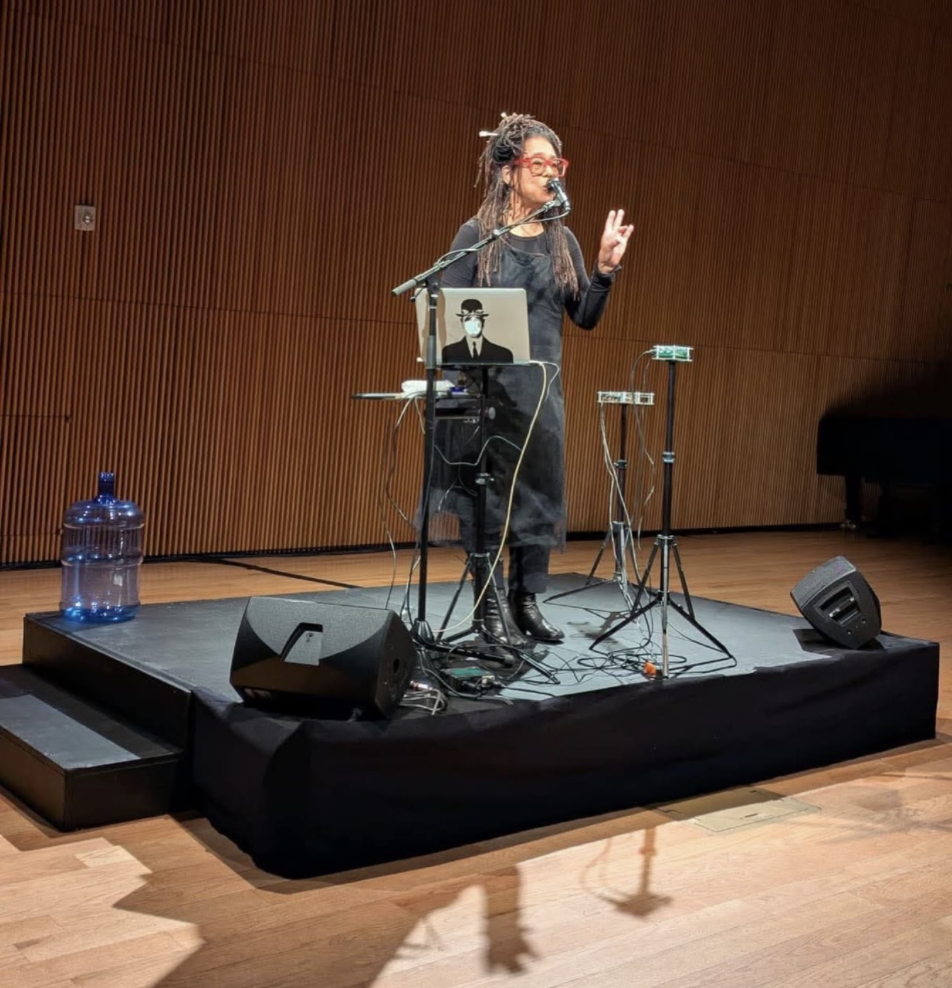
In the world of electronics and motion controllers, where the invention of new ways of sound manipulation is often sufficient to be considered a creative work, the experience of a meaningful, multidimensional sensory space remains rare. Z’s vitality and well-rehearsed spontaneity certainly enlivened the festival’s increasingly diversifying, but still European-dominated programming. Among acoustic nights, my favorite this year was AMOC’s performance of Salvatore Sciarrino’s Stupori, appropriately combined with Michael Hersch’s Carrion-Miles to Purgatory. The first one – six readable silences based on heterogeneous texts where baritone, in Sciarrino’s own characterization, “plays the starring role, with excesses of restlessness, almost bordering on dramatically acted scenes.” The second – thirteen pieces after texts of Robert Lowell, which “simply live in the score” with violin and cello enacting their restrained intensity.
It’s been 11 years since my fear of missing out on New York’s new music life, previously dormant in summer, began to peak in the middle of August. Among 12 concerts at Time: Spans this year, the most important was making the right choice.
Erlena Dlu

