The Art of Experiment: Magda Mayas, Tony Buck, and Nate Wooley

Experimental music demands a performer-composer to be both an artist and a scientist. An artist, who can reach musical integrity and full completeness on the spot “from scratch,” just being there, and a scientist who is in perfect terms with acoustics.  Both roles were accomplished perfectly during two performances of Magda Mayas and Tony Buck (Roulette, September 29th), joined by Nate Wooley (Ibeam, October 14th).

The gig in Roulette resembled an act of sorcery or shamanism. While Magda transformed the piano into a string and percussion instrument, the percussion itself became a cauldron, where Tony was cooking some mystic potion – with small boxes to sprinkle the spices, and a censer to spread the incense. When sounds become magic – are they still sounds? When we hear them as if emerging from the depth of the cave resembling sirens or stones thrown into our ears – are they music? When any sound of environment can be prepared on a musical instrument, should we go back listening to nature? But nature alone could not, as easily as this music did that night, take a listener onto a spiritual trip, with a singing bowl at the end leading to a final meditation that calmed elevated heartbeat.


In experimental music the minimal advance preparation of tunes or sounds plays a role of composition – material that initiates an act with unpredictable outcome. During the trio’s performance in Ibeam the timbral palette became even richer.  Percussion and string sounds coming out of a piano do not require obvious experimentation, but what about imitation of electronic noise? And what about same electronic noise, coupled with refrigerator drones and factory whistles produced by Nate’s muted trumpet blowing into a metal sheet?  The images of acoustic laboratory appeared in my mind, suggesting that a composer role had been taken by the role of a scientist.

A few words on the duo/trio’s audience. Slightly over twenty people in Roulette, which made the place look embarrassingly empty. Twelve listeners in Ibeam (just the right amount for such an intimate place), myself being the only woman. What I described as spiritual trip above, often felt like an almost physical one. It’s hard to say what exactly makes the magic work here – proximity of the performers, or exceptionally rich palette of timbre – but I felt that the sound was physically touching my skin, underneath it, crawling along my spine… Such experience is not rare, but it only occurs with involvement of improvised music, when several players are fully engaged and speak each other’s language, especially when exploring new sounds. Sometimes I wonder why the audience at such concerts is predominantly male. Why women deprive themselves of the pleasure to be touched and caressed in such an exquisite and pure way – by sounds – in the midst of the magic and art of experiment?
Getting rid of glue by means of stone walls – Okkyung Lee and Michelle Boulé at Issue Project Room

We enter the glass door of ISSUE future home – and there she meets us, sliding the endpin of her cello over the stone floor. That the quirky squeak and grinding notes born in the cello’s body are unusual is no news, but the way Okkyung literally gropes the air with sound creates the special connection within the space, placing the audience at the heart of mystic resonance. And we, startled, follow – become resonance ourselves – as all the listeners are a part of the sound, the echo of our footsteps is an element of the performance. Michelle with her conspiratorial wink inflates the air further, creates wind by running up and down the stairs, turning the revolving glass door, dancing the sound and playing it with her eyes.

As we (listeners and performers) enter the theatre space, the sonorous pallet becomes more abundant – acoustical landscape here is enriched with balustrades, Corinthian columns, and vaulted ceilings. More listeners – randomly scattered on the chairs around the place, laying on the floor, following the performers – each one’s experience is genuinely unique. It is the cello we came to indulge our ears with – its rich overtones, wide pitch range and sonorous variety in the body and strings. But not only the ears rejoice – our whole bodies transform into instruments, feeling how sound is born between the ribs.

With her sonorous explorations Okkyung Lee appears to be the truest follower of John Cage – “getting rid of the glue” and letting the sounds be themselves. This is the present history of experimental music.

September 25, 2011

Peter Brötzmann – the Artist of Focusing

Seen from a particular point of view,
music is simply the art of focusing attention on one thing at a time.
John Cage

Free improvisation is difficult to describe or evaluate, if one attempts to talk about music at all.  It is impossible to assess it “objectively,” for in order to enjoy it one must enter the ineffable experience when time disappears, or – becomes vertical. Enter is the right word. You enter the experience of music, or – you let the music enter you. Every word in this sentence can be questioned – experience, you, self, and even music, but enter is true.

Entering – you dissolve, or – the music dissolves in yourself once it enters you. But this only works when improvisation is genuine – when an artist aspires to listen to the eternity of music that exists out there – on the other side of the universe of sounds, and has the capacity to transcribe it for our human ears. Delivering “out there” through the sound “over here.”

On Wednesday, June 8th, 2011, at 10 pm Peter Brötzmann (sax, clarinet), Ken Vandermark (sax), Mars Williams (sax), Kent Kessler (double bass) and Paal Nilssen-Love (drums) performed at Abrons Arts Center. It was the fourth set of the fourth day of the 16th Vision Festival, and the third performance for Brötzmann on that day, right after he was awarded “A lifetime of achievement” prize. The musicians have enjoyed playing together before, and the air was already electrified with the previous sets: readiness to resonate topped with technical virtuosity allowed it to happen.


As any genuine improvisation, Brötzmann’s music allows the listener to achieve an almost palpable physical pleasure building up into complete cosmic unity. The closest possible image is a boundless immensity entering at perineum, sweeping away everything (in a pleasant way), walking up the spine from the inside as a glowing stream of light that hits the crown and finally knocks it up – into the sky, stars and the universe.

How does it work?

Music is magical, but it’s not magic. The musical experience just described is similar to a deep state of meditation when an experiencer achieves complete presence and keeps focusing on the image for a very long time. Being challenging in an abstract setting, it often comes easier with an appropriate music. Complete presence of the listener comes as a result of complete freedom of the sound that nevertheless has a center and a form – the attributes very characteristic of Brötzmann’s improvisation. This evening musicians started with sonorous cacophony resembling chaotic running about of ants that grew in intensity and chaosity, but never to an unbearable state, being intertwined with contemplative calming streams of sound. This capacity for focused musical conception and the ability to carry it through with any group of good musicians from duo to tentet is what allows Brötzmann to hold the listeners’ attention, leading them to a height of musical pleasure. Losing the sense of time completely, the listener can wander in the complete unknown, while still being relaxed with no fear of getting lost, knowing that in the end she or he will arrive at the right place.

And the doors will open for them to enter.

Post-Indeterminancy: Musicircus

On June 4th, 2011 Alotro and Erlena attended an opening of new Brooklyn home of Roulette, where John Cage’s Musicircus was presented. Erlena and Alotro

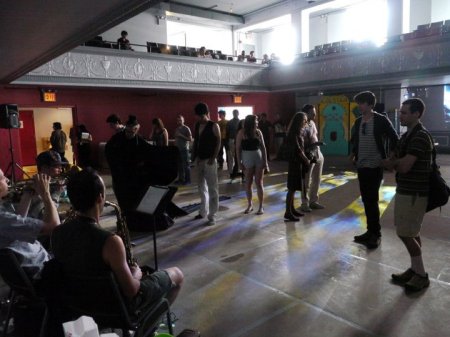
To prepare for appropriate perception of the show, the performance directions were meticulously studied. They stated: “[Musicircus] should last longer than ordinary concerts, starting at 7 or 8 in the evening, and continuing, say, to midnight” and “…there should at all times be many people performing simultaneously.” The act started at 1 pm and finished at 6 pm.  There were as many musicians and groups as the space could fit, allowing audience to walk around freely. All kinds of noises were coming from every corner, including a marching band in front of the building. Some sounds were more attractive than the others. Buckminster’s meditative saxophones and trumpet were enthralling with mystic repetition and blue shadow crawling on the background. Margaret Leng Tan played on two toy pianos, gathering the largest audience. As she moved to a grand for a tango, she held a rose in her teeth to create an appropriate character. When Antony Coleman occupied the piano in the main hall, Erlena hid underneath it to mute the surrounding sounds.  In this way it was possible to focus attention on one thing at a time, as Cage instructed. “Music is the function of distance between the perceiver and the source,” – said Alotro.  At the end of the day their perception of music and self extended.

Indeterminancy is a collection of stories about contemporary music, artists and their audience which John Cage delivered as presentations and lectures in Brussels and at Columbia University.