The Sound of a Fellow New Yorker

One day in August, Rimona shared with me a song –  “that new café… .”   A member of Grace Chorale Brooklyn, and a fellow New Yorker, she said she will sing it repeatedly while other choristers perform different lines, creating together The Mile-Long Opera: a biography of 7 o’clock. “Is David Lang by any chance the composer?” – I asked, as this description immediately reminded me of “the day,” performed at Bang On A Can festival last spring. Simple, repetitive, deeply human… This time also immersive, multi-sensory, site-specific.

Funny, how the absence of references to minimalism and various developments in the history of opera changes everything…
Funny, how the absence of references to minimalism and various developments in the history of opera changes nothing…

It’s October 3rd, and I am standing in line to get into the line which will hopefully lead me to an entrance to the High Line, holding two tickets which Rimona handed to me this morning in one hand, and the hand of another fellow New Yorker in the other. I remember my first summer in the city, when the second section of High Line had just opened, and I fell in love with the concept of a “fellow New Yorker” and its actual representation at the same time. I haven’t started hearing the sounds of The Mile-Long Opera yet, but I already feel its spirit. It’s past 7 o’clock.

Funny, how the lack of references to various post-modern philosophies changes everything…
Funny, how the lack of references to various post-modern philosophers changes nothing…

One way to describe “what happened” “on stage” that night (for a more conventional account, read here) is to “define” a fellow New Yorker, or rather, to map several characteristics of this species, and then say – there were a thousand of them performing a specified script, and several thousand adding improvised elements. A fellow New Yorker is:
1) A person willing to stand in a long line that will lead them to an unforgettable intellectual, cultural, artistic or spiritual experience (remember mile-long lines to The Night of Philosophy, or The Stone benefits on Avenue C, lines to new shows at museums, or – which line is your favorite?).

2) Someone who constantly mourns the closure or relocation of favorite places.

3) Someone who can’t tell the difference between life and art, but loves to discuss it as if they had an advanced degree in philosophy, because they are constantly presented with objects that fit both categories. See those people wiping the windows? Are they a part of the script? You know they are, once the idea is repeated in each window, as you keep walking.

Funny, how the lack of references to John Cage and his ideas of art entering daily life changes everything…
Funny, how the lack of references to John Cage and his ideas of art entering daily life changes nothing…

Verse/Spot 16 (out of 26), “will you marry me.” I am standing on a metal structure above the singers, shivering with excitement, holding the hand of the FNY who made me shiver here before, who said almost the same words just around the corner, in that old café (is it still there?). Personal stories. Making art together. I look into your eyes, you look back, you say, I listen. Simple, repetitive, deeply human.

Erlena Dlu

©2018 by Extended Techniques. All Rights Reserved.

Medea: Exploring the Total Field of Senses

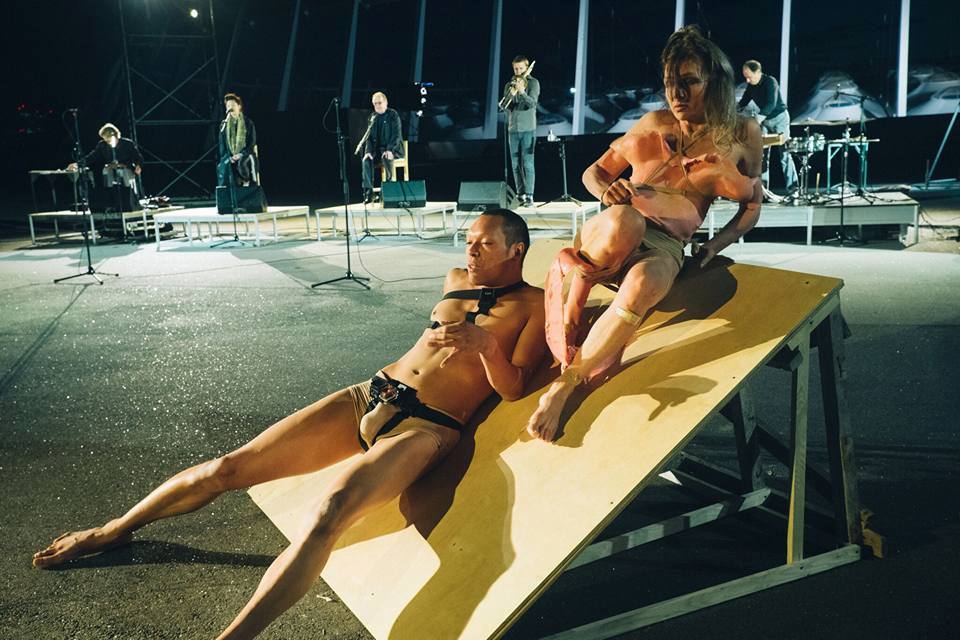
“If John Cage was alive and heard this, he would go nuts,” – said an audience member of Medea, a Pasolini-inspired butoh-opera, staged near Olimpiysky sports complex in Kyiv on June 12, starring butoh dancers Valentin Tszin and Flavia Ghisalberti with music by Audrey Chen (vocals), Phil Minton (vocals), Henrik Munkeby Norstebo (trombone), Thomas Rohrer (rabeca), and Michael Vorfeld (percussion). Of course, such reaction could address a myriad of outdoor performances, and, coming from a pianist who had performed Cage a number of times, was just too obvious. That night, however, another idea of Cage could take on a new meaning, if we replace “sound” with “sense,” which isn’t too much of a stretch, given 21st century urge to multisensory experiences. It seems that this is exactly what the show’s organizer, a highly imaginative music agency Ukho, does best: making Kyiv’s audiences of all ages believe that music is not just sound.

13433145_1250773874947967_8931182437141188109_o

photo by Lili Viter

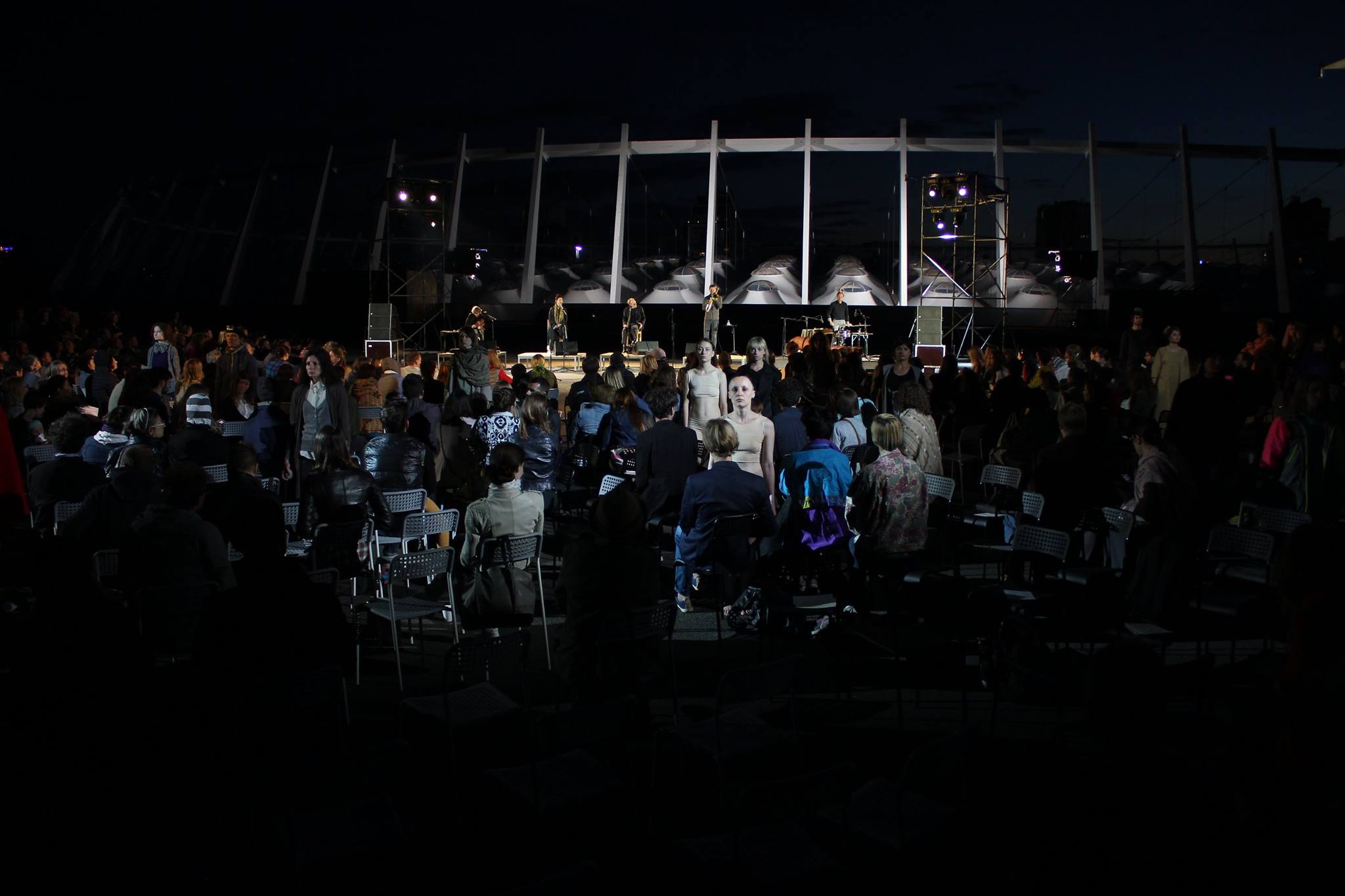
It is the time of the day when the sun breaks up into pieces and scatters over the sky like – cherry blossom? pieces of flesh and blood? I walk past Olimpiysky stadium up the hill, until the voices of football fans recede into silence and the stadium’s UFO-looking roof emerges in front of my eyes – the place’s mysterious view indeed reminds of Pasolini’s desert landscapes. Few hundreds of unordered chairs await the audience; Medea is about to start.

Supposedly without a plot, this genre-bending opera has no melodic lines, let alone arias, but can be perceived as a counterpoint of sensorial threads, on the verge between stasis and narrative. Barefoot dancers, barely dressed in skin-colored clothes, emerge from the audience, writhing with pain. Their suffering becomes our suffering – we could almost touch them and do feel the cold of their freezing feet hitting the asphalt. Humming screams of Minton and Chen can hardly be perceived as sound, but rather as shades of silence that at once project agony and fill up the void. Complete silence would be just too intense – too intense to leave the audience one-on-one with the thriller thread of the performance, by Tszin and Ghisalberti. After several wild acts, such as Tszin getting up the metal construction, the couple meets in a static movement. Their Zen-like concentration and emotionally-charged slow motion vaguely reminds of New York’s Japanese dance couple Eiko and Koma. The subtle eroticism and the dancers’ cruelty to their own bodies, however, is definitely Pasolini’s: replace the mystery of this mixture of beauty and pain with his mysticism, and you arrive at realism – “only those who are mystical are realistic.” Once Jason tears off Medea’s “perfectly real” silicone skin, she scratches her real leg over the sharp edge of a wooden platform.

13418894_10206911950892767_3735482194953725363_n

To add to the opera’s perfect combination of music and movement, yet another sensory line: some thirty butoh-village performers, steadily moving from backstage through the audience, their gaze steadily fixed on the horror which only their eyes can see. Barefoot, with cobblestones on their heads, they slowly walk over freezing ground, and the audience, again, can empathize with no effort. Yet another thread is our freedom to move across the space, choosing a different perspective each time, yet another – the sun going down slowly, in its own pace.

2

photo by Volodymyr Osypenko

Once the listener immerses into visual agony and is completely captivated by the couple, something remarkable happens. The sun goes down, the music switches from lightly-colored silence to scream, the thirty dancers “suddenly” emerge behind our backs, and, having passed the audience, they acquire voice. Once everything reverses, the suffering experienced by Medea and Jason is no longer there – it reverses into silence and stillness of our tortured hearts, from realism to mystery.

Erlena Dlu

©2016 by Extended Techniques. All Rights Reserved.

Medea is a part of Architecture of Voice project, vol. 2: around stadia, curated by Sasha Andrusyk of Ukho Music Agency (Kyiv). Previous shows included: “Blumenstudien” by Lucia Ronchetti in sub tropic orangery of botanic garden, Phil Minton and Audry Chen in paleontological museum, David Lang’s The Little Match Girl Passion in a church, Victoria Polyova’s Ave Maria Stella in a swimming pool, among many others.

Mary Kouyoumdjian’s Silent Cranes: Remembering the Armenian Genocide in Music

Memory is that which, in the end, never betrays.
Serhiy Zhadan

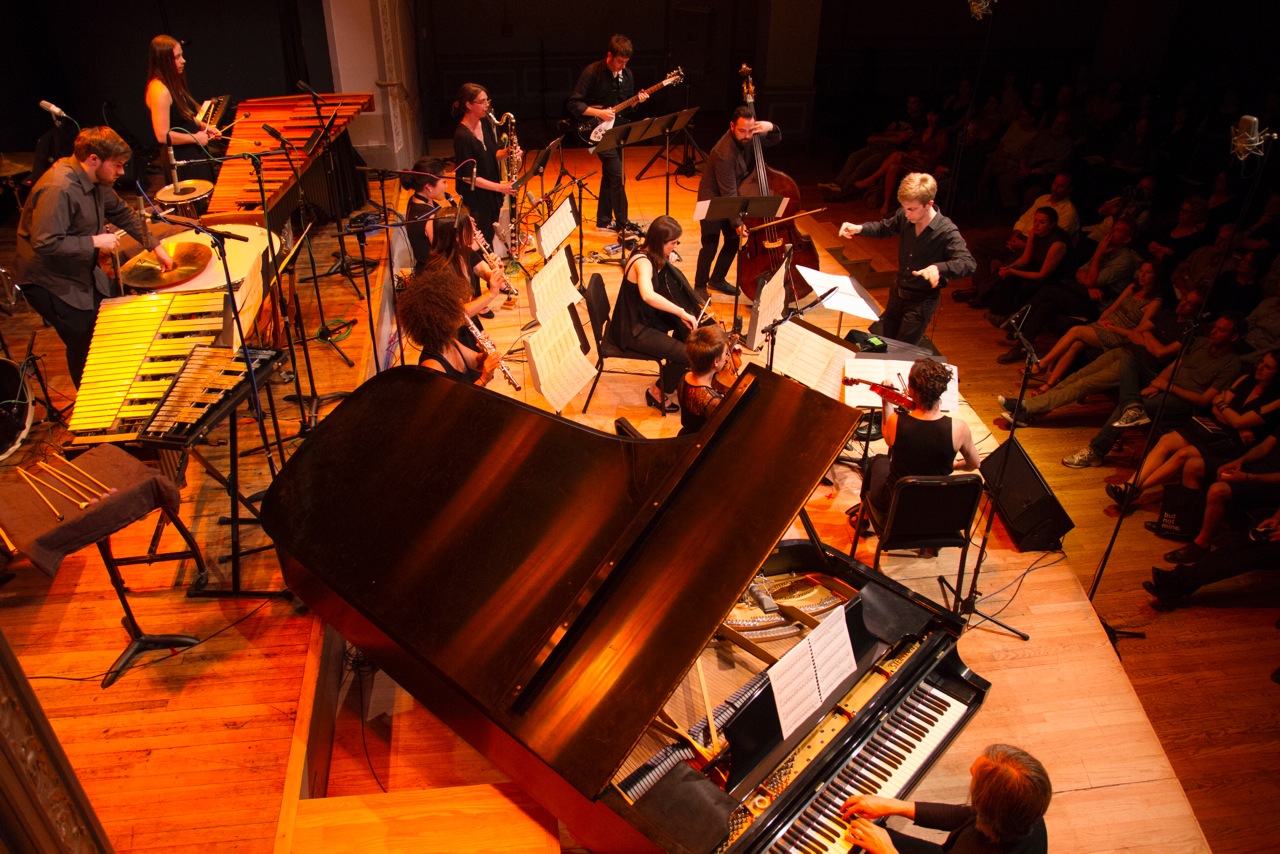
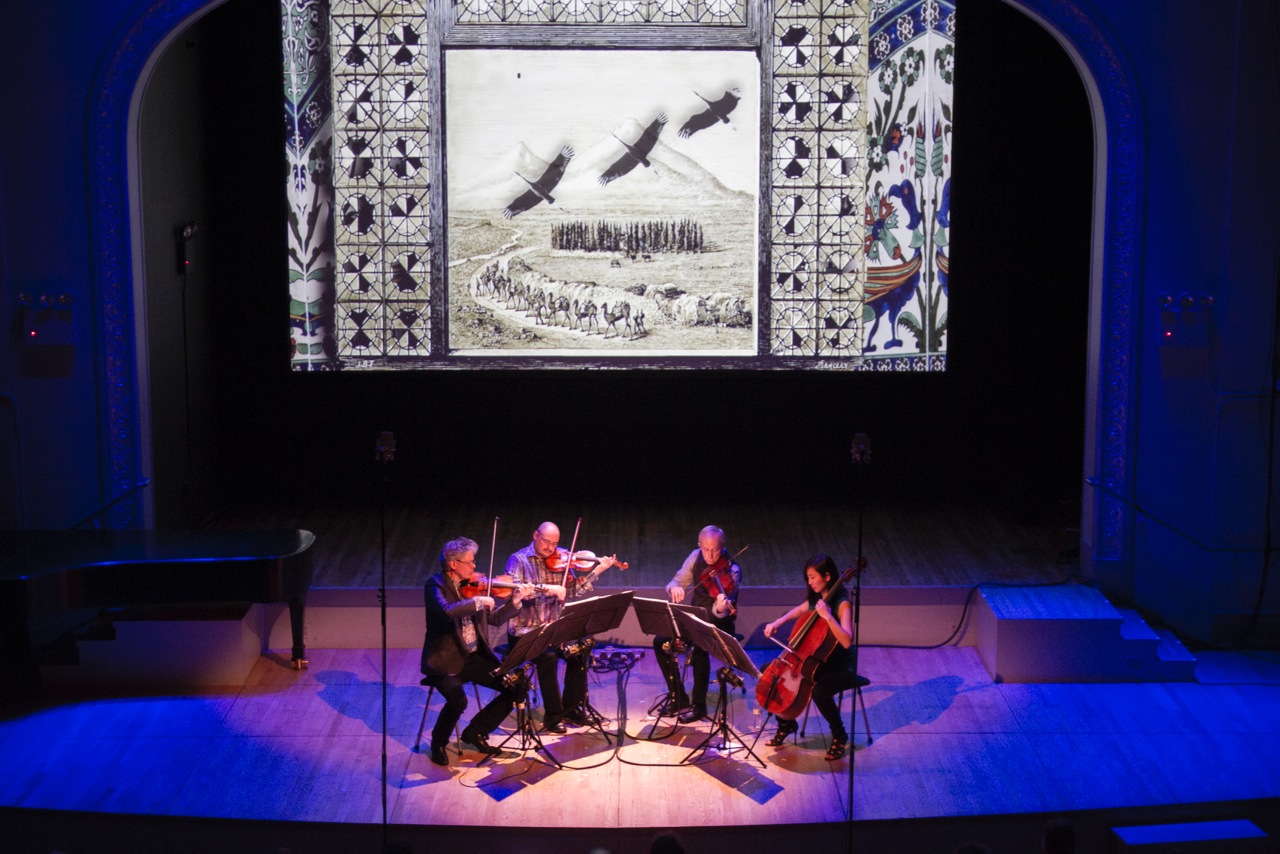
One of many questions triggered by Silent Cranes: The Music of Mary Kouyoumdjian, Performed by Kronos Quartet and Hotel Elefant presented on May 12 in Roulette, is the fragility of the boundary between political art and overt political statement. A descendant of a family that suffered from the Armenian Genocide, Kouyoumdjian shares Sartre’s belief in committed art, and, as Sartre suggests, in her works she recovers this world “by giving it to be seen as it is.”

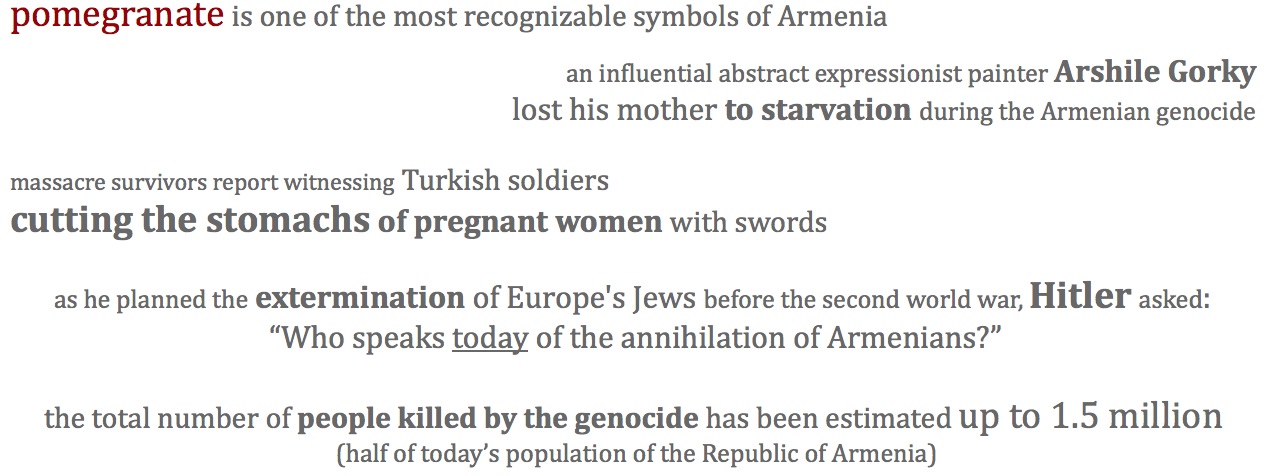
Striving to approach controversial issues through the arts is apt in the case of the challenging topic addressed by Kouyoumdjian. Indeed, it is more common to learn about a century-old tragedy of the Armenian Genocide by experiencing artworks created by the exiled descendants of Armenians, rather than by means of a history lesson. I came to know about it from Ararat (2002), a film directed by an Armenian-Canadian Atom Egoyan, that shares many images and themes with Kouyoumdjian’s work: pomegranates, Arshile Gorky, Turkish soldier cutting the stomach of a pregnant woman, Hitler’s infamous inquiry, 1.5 million killed.

Kouyoumdjian’s music is able to transmit state of madness, exemplified in two portraits of genocide survivors – composer Komitas who suffered post-traumatic disorder after his deportation to a prison camp, and painter Gorky, who lost his mother to starvation. Sea of Two Colors (2011) transports the listener to the realm of a restless soul of Komitas; flowing piano trills of the sea can also be heard as dark sinister clouds that cover once clear mind of a legendary composer and, with a brief moment of transfiguration, dissolve into eternity. Gorky’s voice in Everlastingness (2015) sounds completely detached from the accompaniment (reminding of Schumann’s songs), as the protagonist, consumed by his memories, lives in a fever dream beyond reality.

Photo by Dominica Eriksen

Gorky’s ruminations didn’t engulf me as strongly as the last piece performed by Hotel Elefant: This Should Feel Like Home (2013) indeed felt like contemporary Armenia the way I imagine it, with all the imprints of the past. Folk melodies, marching band, distant voices, Orthodox church singing returning time and again – these recorded sounds naturally blended with their own reflections on the piano, flutes, clarinets, and strings.

The title piece of the concert, a four-movement multimedia work performed and commissioned by Kronos Quartet, seemed somewhat less integrated. The first movement appropriately introduced some highlights of Armenian cultural heritage: projected images of beautiful rugs and ceramics, traditional costumes and architecture, an old recording of Komitas music and his portrait on the screen. In the following movements pomegranates decomposed into blood as my ears submerged into survivors’ testimonies, my heart pierced with every word. I felt that these words were too numerous and too literal, leaving the music no role other than an accompaniment to a documentary film. After so many atrocities copied from real life and pasted into the piece, some of the conclusions in the last movement seemed redundant. Shocked by the work’s content, I felt imprisoned by the abundance of words. One of my inner voices resisted the idea that the facts, the images, the narrative and the conclusions were all thrown into my face so literally, leaving no room for reflection.

Photo by Dominica Eriksen

I’ve always believed that art should favor the figurative over the discursive, especially in the music; but further reflections on Kouyoumjian’s Silent Cranes proved that its case might be different. The piece bears many similarities with Schoenberg’s A Survivor from Warsaw (1947), famously criticized by Adorno for its literal depiction of suffering. The subject in each piece is personal to both composers, both works are based on the reports of survivors (although Survivor has a fictional narrative and it is not clear whether any reports at all are quoted directly), and the text is clearly recited. Moreover, both works stress the role of memory, although, ironically, in Schoenberg’s, written right after the Holocaust, the narrator “cannot remember everything,” while Kouyoumjian digs a hundred years into the past to give voice to someone who “was young, but still remembers.” One more twist of irony: in 1915, The New York Times systematically reported on the mass murder of the Armenian people, while the atrocities of the Holocaust were not immediately disclosed. And what do we remember today? Perhaps the artists who address the events forced into oblivion by the political will, have a right to be fully committed (i.e. realistic) – this is the only way time can lose its battle to memory.

Erlena Dlu

©2015 by Extended Techniques. All Rights Reserved.

Just between you and me: Anthony Braxton’s Trillium J is the future classic

On April 19, having rushed to Roulette leaving behind the last minutes of an international Sound and Affect conference in order to experience Anthony Braxton’s Trillium J (The Non-Unconfessionables), at first I could not stop thinking: how does this performance affect me and why? And – “whose are these emotions?” – as Deniz Peters questioned earlier that day.

I fail to describe my feelings having never experienced anything like this before. Perhaps one could compare Trillium J to Richard Foreman’s plays in the way it captures the absurd, the unexpectedness and ambiguity of contemporary world. Weave these into the voices of 12 vocalists and the sounds of 12 instrumental soloists with full orchestra, excellent acting, pseudo-philosophical digressions, visual projections, young skipping-rope Jazzy Jumpers and two of New York’s best contemporary dance improvisers Rachel Bernsen and Melanie Maar, and you get the mix.

At any specific moment I could not  recognize what exactly (music, words, acting, etc.) made me smile in a very strange way – the smile that sometimes comes from experiencing the misfortunes of Daniil Harms’s characters. This is perhaps the genius of a gesamtkunstwerk artist (Braxton wrote both the music and the libretto) – to blend all the media so naturally that a spectator cannot recognize the source of their feelings.

How does the absurd feel?

As an interlude before the Second Scene of Act IV, Jazzy Jumpers entered with their skipping-ropes and the choir started improvising “random” sounds to their movements. I sensed tears in my eyes, obviously neither out of sadness or joy. What catalyzed the sublime was (perhaps?) the excitement that something so contemporary and so musically apt was composed –the genre of opera has a future; at least it definitely has a present.

But the climax was still to come. The interlude could either feel like just another meaningful nonsense – the ridiculousness that was so fittingly at the wrong place, – or depict a stratum of society to be juxtaposed with the final scene – the trial of Sally Wanton. Despite the obvious references to social injustices of American society, Ms Walton reminded me of Russian President Vladimir Putin in her ability to pour complete nonsense and reject obvious evidence of crime with complete confidence (as well as accept it and immediately render crucial statements trifle). This is where, perhaps, “the concept of affinity,” the opera’s major theme, lies. Everyone walked out with a radiant face – those who thought of multiple possibilities of political connotations, or those who just took “the poetic transiency” and “undefinition that seeks its own level” as a flow of beautiful nonsense.

George Crumb once said that he was “frightened of a possibility to write an opera, nothing comes close to Wozzeck.” Whether you agreed with that or not in the past, you would definitely have to consider replacing Wozzeck with The Non-Unconfessionables.  Should 21st century opera, and music for that matter, only be political? It is not always this or that, it is often the other.

Erlena Dlu

©2014 by Extended Techniques. All Rights Reserved.

Symbolism in Sofia Gubaidulina’s Spiritual Music

Today’s program of FOCUS festival Alfred Schnittke’s World features a piece by Sofia Gubaidulina (b. 1931), In Croce (1979). Gubaidulina’s music is  symbolic and imaginative, employing unusual instrumental combinations and extended techniques. The symbolism behind the sounds often carries spiritual connotation; in 1998 the composer stated that all her works were religious, which in her understanding is not related to the church. This is one of the reasons why some of her music was unwelcome in the USSR and some works were not performed until its fall.

Gubaidulina is one of the most spiritually inspired composers of our time. The belief in the religious purpose of art has deep roots back to her childhood and was strengthened during her youth when she encountered the writings of a philosopher Nicholas Berdyaev and met a brilliant pianist Maria Yudina, who maintained her strong religious commitment despite political repressions. Gubaidulina’s first engagement with music-making in 1937 coincided with a spiritual experience of significant impact: at the age of six, when she began to play the piano, she came across an Orthodox Christian icon. As Michael Kurtz quotes her in his monograph: “Music naturally blended with religion, and sound, straight away, became sacred for me.”

The connection between Christian commitment and artistic creativity was further strengthened during Gubaidulina’s philosophical quest when she learned about Berdyaev’s idea of linking the inner and spiritual realm to the perception of time: “Creativity… is the flight into the infinite… [an activity] which transcends the finite towards the infinite. The creative act signifies an ek-stasis, a breaking-through to eternity.” The sacredness of art is a completely natural phenomenon for Gubaidulina, and her aesthetic statement is not that of a style, but of art’s relationship with religion through the re-linking of everyday life with vertical inner nature of human perception:

What is religion at all? For me this concept is literal, re-ligio – a ligature that connects horizontal line of our life and vertical line of our divine presence. Anyone who creates, for example a poem, enters this vertical realm. Such a person is capable of perceiving, at least a little bit, what exists in this dimension. (Interview with Aleksey Munipov, 2012)

Gubaidulina believes that daily routine may lead a person to lose the connection with the inner world, and therefore people need creative activity as an inspiration to get outside of everyday life: “Life interrupts this connection: it leads me away, into different troubles, and God leaves me at these times… This is unbearable pain; by creating, through our art, we strive to restore [the link between us and God] (interview to Vera Lukomsky, 1998). In the same vein, art transforms the horizontal time of everyday life into a vertical time of inner, spiritual existence: “A person may not be conscious of it, and creativity can be … of any sort, but the shape of the outcome turns out as a staircase, vertical.” (Interview with Munipov)

In Croce was originally composed for cello and organ, later arranged for cello and bayan, but tonight will be performed in its original version. The piece belongs to the period when Gubaidulina began to consciously construct her compositions on the basis of philosophical or spiritual symbols that shaped the form and the sound of the piece frequently requiring unconventional performance or extended instrumental techniques. In her biography by Michael Kurtz she explains the symbolism behind her choice of instrumentation and the form in In Croce:

In that particular combination I imagined the organ as a mighty spirit that sometimes descends to earth to vent its wrath. The cello, on the other hand, with its sensitively responsive strings, is a completely human spirit. The contrast between these two opposite natures is resolved spontaneously in the symbol of the cross. I accomplished this by criss-crossing the registers (the organ takes the line downward, the cello upward); secondly, by juxtaposing the bright major sonorities of natural harmonics, played glissando, and expressive chromatic inflections.

Erlena Dlu

 ©2014 Extended Techniques. All Rights Reserved.