On June 1-3, the Vienna Festival (Wiener Festwochen) hosted three nights of Mōdraniht. Songs of Winter War – the third experimental opera in the environmental trilogy by the creative collective Opera Aperta. The show had previously been performed at O. Festival in Rotterdam on May 26 and premiered on May 10 in Kyiv, where the company’s rehearsal space has since been destroyed by a Russian missile attack. To create this production, composers Roman Grygoriv and Illia Razumeiko traveled to Northern Spain, the Carpathian Mountains, and Uzbekistan to document winter solstice rituals and the present condition of the dried-up Aral Sea.
The previous two productions in the trilogy were quite remarkable – Chornobyldorf received the Royal Philharmonic Society’s award for the best opera, running against Kaija Saariaho’s Innocence, and GAIA-24. Opera del Mondo received the 2025 Music Theatre Now Award. Yet Mōdraniht is certainly more original, deeper, and overall, much stronger both musically and dramaturgically. The music amplifies the emotional charge of visual sequences in just the right way; moreover, it could easily exist as a stand-alone piece, apart from those moments when it dissolves into silence, quotations from the classics, and the ringing of cow bells. The timing between unexpected scene changes is perfectly calculated. A Richard Foreman play, but with meaning?
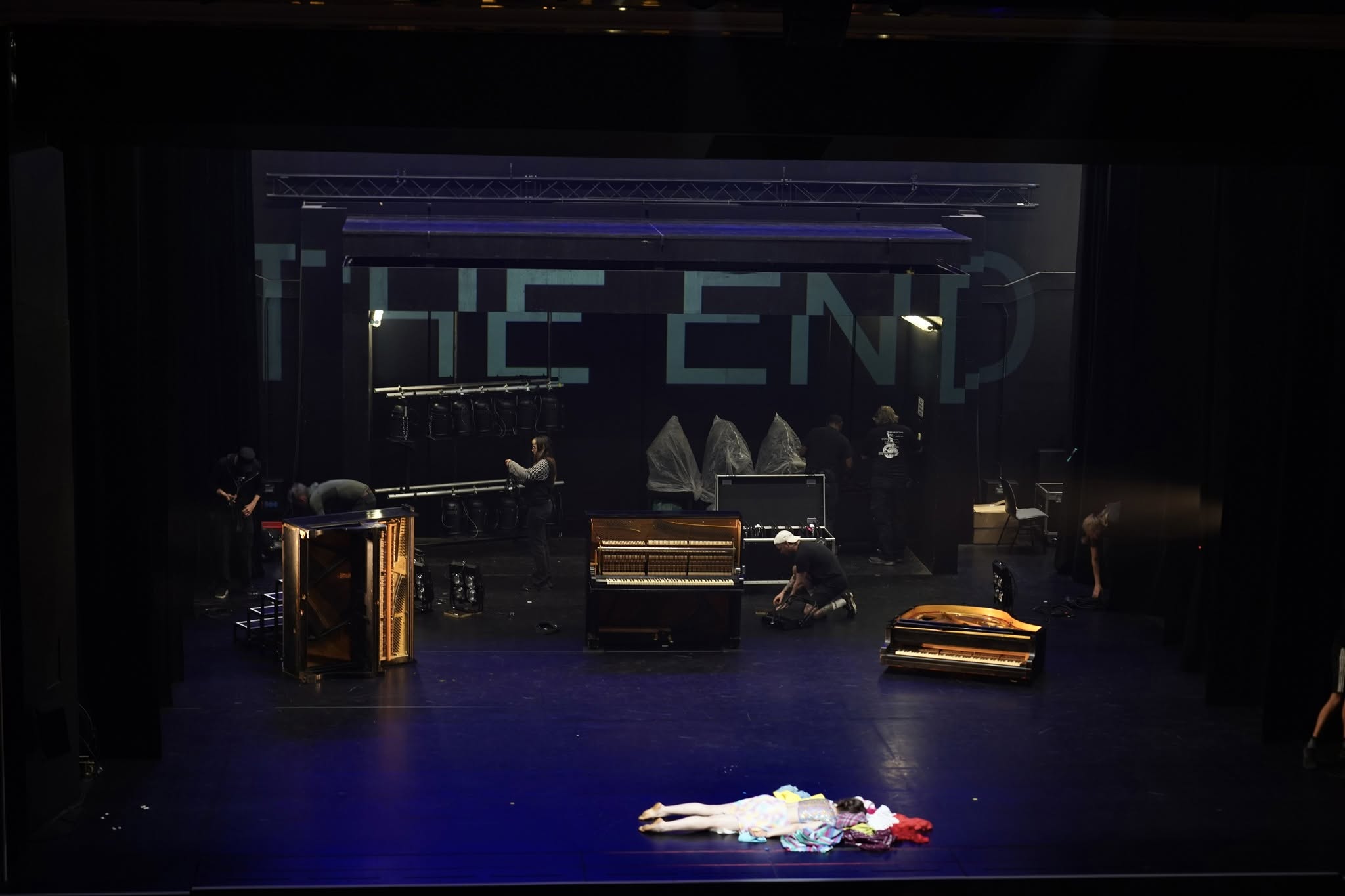
The meaning was clarified in Razumeiko’s introductory remarks. (Neither winter nor war explicitly appear in the production itself, except for the artist-led Q&A session with the audience, in the middle of the show.) Switching between English and German, to engage both international guests and locals, he explained the origin of some visuals and props: the ships in the desert demonstrate the results of Russian colonization – the draining of the Aral Sea, the injured face belongs to a recently discharged Ukrainian veteran, and the partially destroyed pianos symbolize those that were looted by the Red Army soldiers from Austria in 1945. These facts made the abstract production that followed feel timely, yet I imagined its existence without any explanations, as the aesthetic quality of the piece can certainly ensure its timelessness.
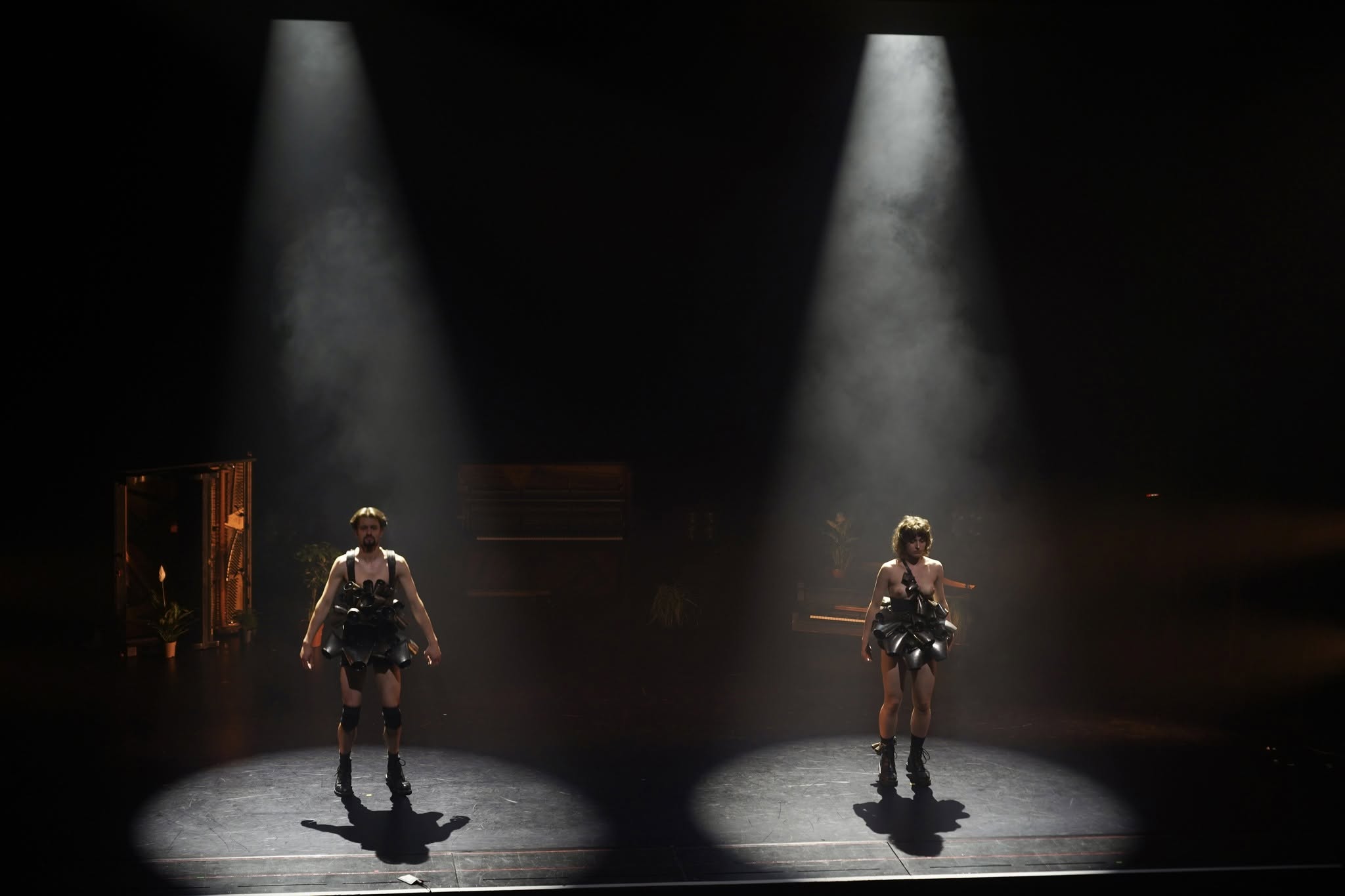
By all counts, the artists of Opera Aperta are superhumans. The cast consists of professionals trained as singers (operatic or folk), dancers, string or percussion players, but each has mastered the drums, strings, pianos, and other instruments and objects. With any and all parts of their bodies, they play a mesmerizing sequence à la Boulez’s Piano Notations, where every note, tone cluster, and silence musically make perfect sense. (The positions include leaning perpendicularly to play with the crown of the head on a piano positioned sideways, and doing push-ups while stretched along the keyboard, which is possible only because of the enormous strength in Marichka Shtyrbulova’s tiny body.) Mingling with the audience, the performers can create a stereophonic sound by jumping incessantly for over 15 minutes while wearing 350 bells, ranging in size from an apple to a watermelon. They can also flawlessly sing six-part polyphony while all piled up on top of each other, in upside-down or sideways positions that seem to defy the existence of gravity. (The singing happens after the bells episode, and no one seems to be out of breath.)
Mōdraniht, however, is not merely a collection of startling effects or a show-off of improbable skills. It’s a work of high art that leaves you startled, with eyes wide open and many questions. (Is it really over? Why do the lights project “The End” while the music is still playing, one artist is still lying on the stage, and no one comes out for a bow to greet the puzzled, hesitantly clapping audience? And, more importantly, when are they coming to New York?)
Erlena Dlu
©2026 by Extended Techniques. All Rights Reserved.

